For three decades, the golden rule of digital marketing was simple: rank #1 on Google, win the clicks, and grow your business. If you could land a spot in those coveted “10 blue links,” your traffic pipeline was secure.
But the click-based web is being quietly retired.
When a user searches for a solution today, they aren’t scanning a list of separate websites. They are reading a single, synthesized response written in real-time by an artificial intelligence engine. Between Google’s AI Overviews, Perplexity, and ChatGPT, the traditional search landscape has fundamentally fractured.
TL;DR / Quick Summary
Generative Engine Optimization (GEO) is the practice of structuring, writing, and formatting digital content so that AI search engines synthesize, cite, and recommend your website inside their conversational answers. While traditional SEO optimizes for page placement, GEO optimizes for information extraction and citation inclusion.
Introduction: The Death of the “10 Blue Links”
What is Generative Engine Optimization (GEO)?
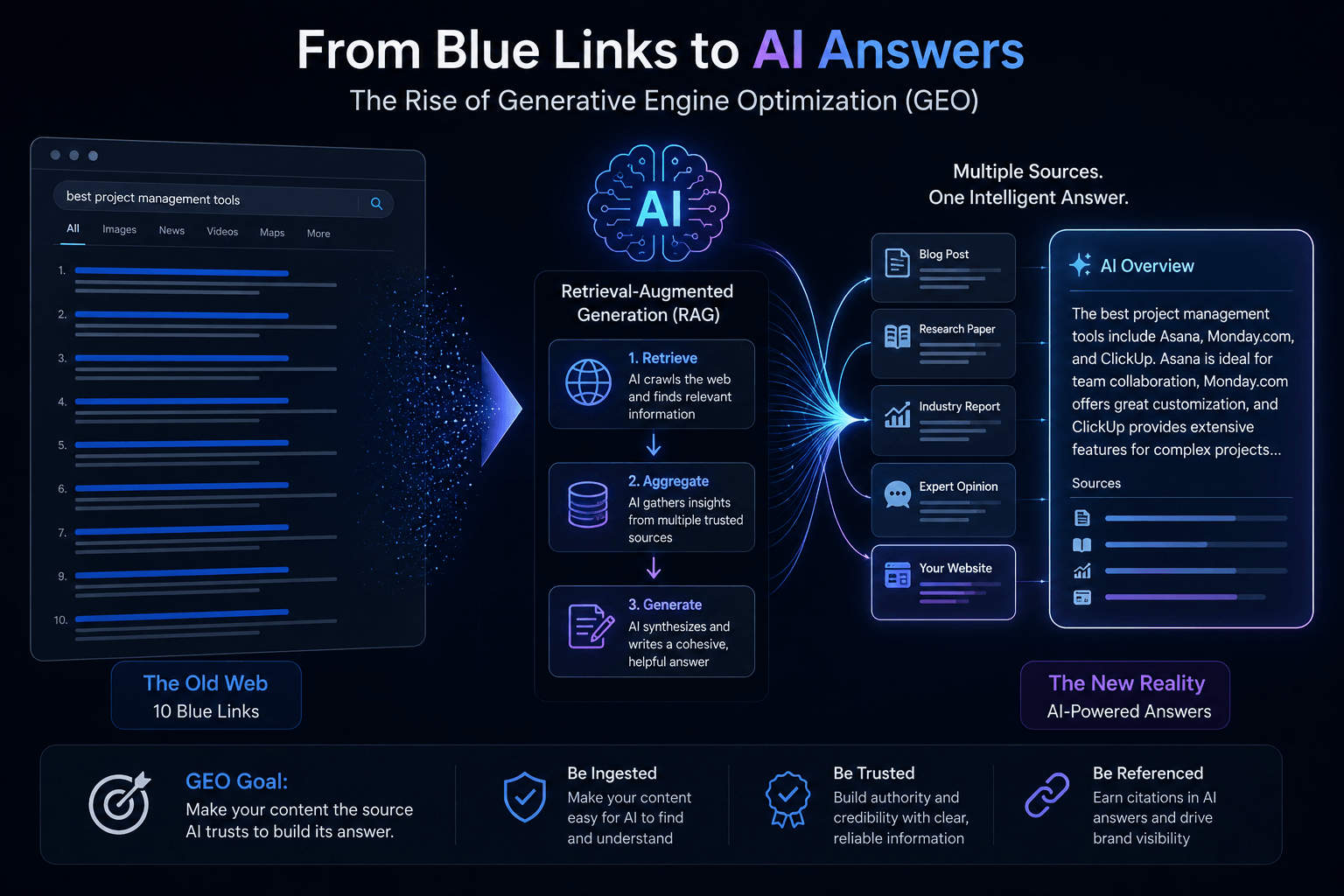
Generative Engine Optimization (GEO) is the next evolution of digital visibility. It is a strategic optimization framework designed to ensure your brand’s data is ingested, trusted, and referenced by large language models (LLMs) when they pull information from the live web.
When a user submits a prompt to an AI search engine, a process called Retrieval-Augmented Generation (RAG) occurs. The engine crawls the web, aggregates findings from multiple documents, and rewrites them into a cohesive response. Your goal with GEO is no longer to get a user to click your link from a list; your goal is to make your content the source material the AI relies on to build its answer.
Why traditional SEO is no longer enough?
If you are relying solely on an outdated SEO playbook, you are invisible to a massive portion of your audience. Recent 2026 data reveals a staggering shift in search behavior: AI Overviews now trigger for roughly 51.5% of all Google queries. When that AI box appears, it completely dominates the desktop and mobile viewport, causing the top-ranking traditional organic result to suffer an immediate 58% collapse in click-through rates.
Even more alarming for traditional marketers is the breakdown of historical ranking logic. Seven months ago, nearly 76% of AI citations came directly from the top 10 organic search results. Today, only 38% of pages cited in AI Overviews rank in Google’s traditional top 10.
The remaining 62% of citations are pulled from pages ranking lower on the web, or outside the top 100 entirely. The message from the algorithms is clear: your website can rank #1 on traditional Google search and still be completely bypassed by the AI if your content isn’t optimized for machine ingestion.
To survive the end of the click era, you have to stop optimizing for standard search algorithms and start optimizing for generative engines. Here is exactly how the game has changed.
SEO vs. GEO: What is the Difference?
To successfully optimize for the modern web, you must understand a fundamental truth: Traditional search engines read; generative engines synthesize.
While traditional Search Engine Optimization (SEO) and Generative Engine Optimization (GEO) share a foundational requirement for high-quality, technically sound content, they treat your website through completely different lenses. SEO views your site as a destination link to be ranked. GEO views your site as a trusted data repository to be mined.
Keyword matching vs. Entity authority
Traditional SEO has always centered around the keyword. You research what phrases users type into a search box, map out search volumes, and strategically place those keywords in your title tags, headings, and body copy. The search engine’s algorithm checks your page-level keyword density, matches it to the query, and calculates your ranking heavily based on the strength of your backlink profile.
GEO completely breaks away from exact-phrase matching, shifting the focus to Entity Authority and Semantic Depth.
Generative AI models do not just look for matching strings of text; they break down language into “entities”—verifiable people, places, things, organizations, or distinct concepts. When a user asks an AI engine a multi-variable question, the system uses its underlying knowledge graph to trace how entities connect.
- [Traditional SEO] –> Targets Specific String –> “Best CRM for startups”
- [Generative GEO] –> Maps Related Entities –> Brand + Integrations + Team Size + Pricing
Instead of rating a page based on isolated keywords, generative engines assess its semantic depth—meaning how thoroughly and accurately your content maps out a core topic’s attributes, definitions, and conceptual relationships. A lower-ranking traditional web page that features clear, precise entity definitions, logical formatting, and high-density information will routinely beat out a #1 ranking SEO page if the latter relies on generic marketing copy or vague, fluff-heavy explanations.
The SEO vs. GEO Comparison Matrix
| Comparative Dimension | Traditional SEO (Search Engine Optimization) | GEO (Generative Engine Optimization) |
| Primary Goal | Secure a position on Page 1 of search engine results pages (SERPs), ideally in the top three “blue links.” | Maximize brand inclusion, authoritative citations, and factual recommendations within a synthesized AI response. |
| User Input & Intent | Short, transactional, or informational keyword phrases (e.g., “best CRM software”). Average length is 3 to 4 words. | Long, conversational prompts, multi-variable questions, or problem statements (e.g., “Which CRM is best for a 50-person remote team using Slack and looking to automate onboarding?”). Average length is 15 to 25 words. |
| Primary Audience | A human consumer scanning a page of diverse web links to choose a destination. | An AI Large Language Model (LLM) scraping, parsing, and selecting a trusted entity to formulate its single authoritative answer. |
| Core Optimization Focus | Technical & Architectural: Backlink profiles, keyword density, internal linking, URL structures, and page loading speeds. | Content Structure & Semantic Depth: Authoritative citations, expert quotation insertion, data-backed proof points (“statistical hardening”), and clear schema markup. |
| Primary Metric for Success | Click-Through Rate (CTR), Organic Traffic Volume, Core Web Vitals, and Target Keyword Rankings. | Share of Voice (SoV) across LLMs, Chatbot Reference Rate, Brand Sentiment, and Co-occurrence (how often your brand is mentioned alongside relevant industry keywords). |
| Discovery Funnel | On-Page Dominant: Heavily relies on your own website’s content, structure, and direct authority metrics. | Ecosystem Dominant: Relies on off-site data, structured review sites (e.g., G2, Yelp), user-generated forums (Reddit, Quora), and digital PR to build global entity trust. |
| Content Lifecycle & Volatility | Gradual & Predictive: Rankings typically adjust slowly over weeks or months based on competitive updates and link acquisition. | Dynamic & Highly Volatile: Recommendations can shift drastically depending on real-time retrieval triggers (RAG), context window constraints, and model weights during retraining updates. |
The metrics that matter now
Because the delivery mechanism of search has fundamentally shifted, the key performance indicators (KPIs) we use to measure success must evolve too. If you evaluate a GEO campaign using an old SEO dashboard, you will completely miss the mark.
Traditional SEO measures performance using direct traffic-driving metrics: Position on the SERP, Impressions, Click-Through Rate (CTR), and Organic Sessions.
GEO, on the other hand, operates in a reality where the user journey frequently ends in a “zero-click search.” When an AI assistant answers a prompt comprehensively, a massive percentage of users read the generated summary and end their session right there, never clicking through to any website.
Because of this, GEO shifts your focus to a completely new set of metrics:
- Chatbot Citation Rate: The exact percentage of times your brand or website is actively used as an external reference or linked source when an LLM answers a specific set of target industry queries.
- Share of Voice (SoV) in AI Overviews: Monitoring how frequently your product, service, or insights are recommended by name across major models like ChatGPT, Perplexity, and Gemini compared to your direct competitors.
- Brand Entity Co-occurrence: Tracking how strongly generative models associate your brand name with specific industry categories, frameworks, or problems when summarizing information.
Winning at GEO means accepting a mindset shift. You are no longer just optimizing to capture immediate web clicks; you are optimizing to build durable brand equity within the very datasets that AI engines trust to formulate their answers.
The Core Elements of a Winning GEO Strategy
Transitioning your brand from standard SEO to GEO requires a deliberate structural, linguistic, and technical overhaul. You are no longer trying to look relevant to a basic keyword index; you are making your content highly extractable and structurally undeniable to an AI system.
A successful, high-yield GEO strategy rests upon three foundational execution pillars: Technical Infrastructure, Information Density, and Trust Signals.
1. Machine-Readable Infrastructure (The Technical Pillar)
Before an AI engine can synthesize your content, its underlying retrieval bots must be able to parse your codebase cleanly. Heavy, client-side JavaScript frameworks or poorly configured backend rules will lock AI crawlers out entirely.
To build an AI-friendly technical architecture, prioritize these three elements:
- Audit Bot Access: Ensure your
robots.txtfile is explicitly configured to permit entry to generative user-agents. Blocking crawlers likeChatGPT-User,PerplexityBot, orGoogle-Extendedguarantees total exclusion from conversational answers. - Deploy Semantic HTML: Use clean, predictable HTML tags ($H1$, $H2$, $H3$, $p$, and $ul$). Generative models utilize structured headers to quickly isolate the exact segment of your page that answers a user’s intent.
- Implement Advanced JSON-LD Schema: Structured data is the native language of AI indexing. Implement comprehensive
Article,FAQPage, andProductschemas across your site. By explicitly declaring your content’s entities, authors, and data fields in a standardized code snippet, you prevent the model from misinterpreting your data layout.
2. “Statistical Hardening” and Citation-First Copy (The Text Pillar)
LLMs are naturally prone to hallucinations—making things up when they lack concrete data. To protect their own accuracy, search-based AI models are heavily programmed to favor high-density, authoritative data points that can act as unshakeable anchors for a summary snippet.
The practice of transforming vague prose into concrete data is known as Statistical Hardening. Furthermore, your writing layout must adapt to a Citation-First Content Structure, positioning your primary answers directly below your question headings.
- [Traditional SEO Prose]: “Implementing a cloud-native architecture can vastly optimize your operations, reduce overhead costs significantly, and help your engineering teams scale up workflows much faster than traditional methods.”
- [GEO-Hardened Text]: “Switching to a cloud-native architecture reduces infrastructure overhead by 31% and accelerates code deployment velocity by 4.2x, according to data from the 2025 DORA Metrics Report.”
By packaging your copy with specific percentages, direct numbers, and upfront clarity, you drastically increase the likelihood that an engine’s text-extraction algorithm will select your exact paragraph as the definitive quote.
3. Expert Endorsements and the Trust Hierarchy (The Trust Pillar)
A breakthrough, peer-reviewed academic study published by researchers at Princeton University, Georgia Tech, and the Allen Institute for AI analyzed exactly what content modifications force AI models to credit a website.
The data revealed that you do not need to radically redesign your website to win AI citations. Instead, you must layer specific trust signals directly into the body text.
The Princeton-led research proved that integrating three specific “textual enhancements” yielded the highest visibility gains across generative search engines:
- Expert Quotation Addition (+41% visibility boost): Embedding direct, attributed quotes from verified industry professionals. AI engines use these to add perspective and authoritative weight to their summaries.
- Statistical Hardening (+32% visibility boost): Replacing generalized claims with explicit, quantified metrics and data points.
- Authoritative Source Citations (+30% visibility boost): Outlining clear inline references and outgoing links to trusted third-party repositories, academic studies, or foundational market reports (e.g., “According to a 2026 Gartner analysis…”).
By designing your content around this trust hierarchy, you give the generative engine the legal and algorithmic confidence it needs to cite your brand without risking an inaccurate output.
Also read: Unleashing the Power of AI in Your Digital Marketing Strategy
The Off-Page Ecosystem: Where AI Actually Finds You
Why is your website only 30% of the puzzle
One of the biggest mistakes marketers make when pivoting to GEO is assuming the battle is won entirely on their own domain. In the classic SEO playbook, on-page optimization combined with standard link-building was the entire engine.
GEO flips this script. Because Large Language Models rely heavily on a synthesis of the entire web to determine entity consensus, your owned website accounts for only about 30% of your total AI visibility. The remaining 70% of an AI’s decision to recommend you relies on your external ecosystem.
Optimizing the “70% Moat.”
If an AI search engine reads your website and finds amazing claims, it validates those claims by cross-referencing off-site datasets before generating a user response. To build an unbreakable off-page presence, you must optimize across three distinct external channels:
- User-Generated Content (UGC) Platforms: Generative search engines heavily bias their recommendations toward authentic human experiences. This has caused an explosive surge in crawlers indexing sites like Reddit and Quora. To show up in AI product recommendations, your brand must have an active, natural footprint of real users discussing your solutions on these forums.
- Third-Party Review Aggregators: For B2B and B2C brands alike, LLMs scrape platforms such as G2, Trustpilot, Google Business Profiles, and Yelp to assess customer sentiment. AI search engines calculate your average ratings, extract specific user feedback themes, and use that synthesized data to populate comparison lists.
- Digital PR & Entity Co-occurrence: Securing mentions in authoritative industry publications, newsletter digests, and independent comparison tables creates strong semantic associations. When your brand name repeatedly co-occurs in paragraphs alongside top industry keywords on neutral, highly trusted journalistic sites, LLMs permanently link your brand entity to those high-value target categories.
Also read: Optimizing your website for generative AI features on Google Search
Conclusion: How to Start Auditing Your Brand for GEO
The shift from traditional search engines to generative AI answers isn’t a trend that’s arriving in a few years—it is the reality of the web today. If your content strategy remains locked in a 2020 mindset of tracking keyword density and chasing basic blue links, you are voluntarily surrendering your brand’s digital visibility to competitors who are optimizing for machine ingestion.
To win at GEO, you don’t need to scrap your existing content infrastructure completely. Instead, you need to refine it so that it acts as a highly scannable, data-dense, authoritative reference asset for LLMs.
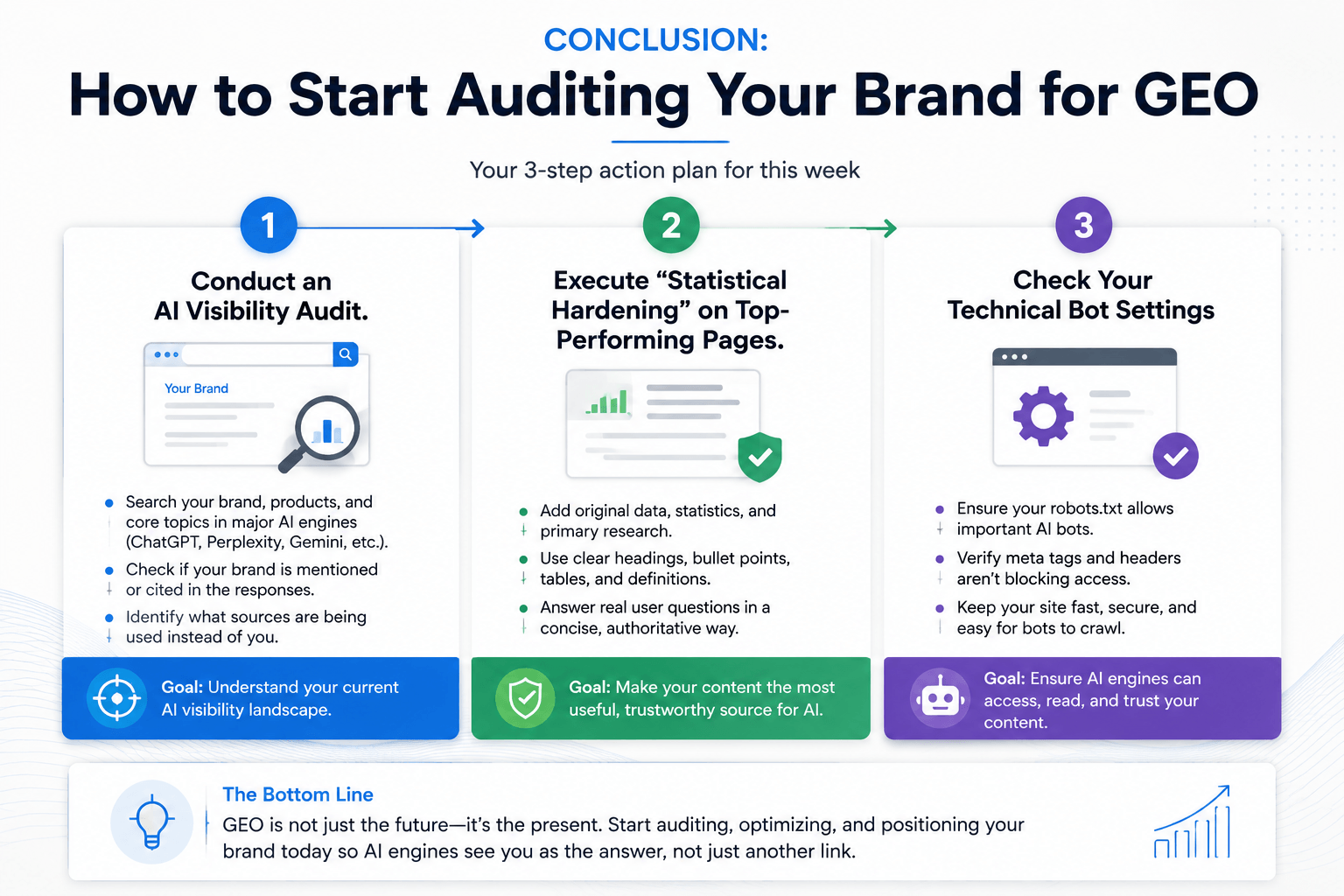
Your 3-step action plan for this week
If you want to immediately protect your search footprint and start capitalizing on AI Overviews and conversational engine traffic, execute these three steps over the next seven days:
- Step 1: Conduct an AI Visibility Audit. Stop guessing how AI engines perceive your brand. Open up ChatGPT, Perplexity, and Gemini, and prompt them with your industry’s top informational queries (e.g., “What are the best enterprise inventory management frameworks for scaling e-commerce businesses?”). Track whether your brand is mentioned, how your products are described, and what sources the AI uses to back up its recommendations. This establishes your baseline Share of Voice (SoV).
- Step 2: Execute “Statistical Hardening” on Top-Performing Pages. Identify your top 10 highest-traffic blog posts or landing pages from your traditional SEO dashboard. Rewrite their introductions to include a bolded “TL;DR Summary” block. Then, systematically strip out vague marketing filler and replace it with hard numbers, precise percentages, and direct expert quotes. Give the AI the high-density anchors it needs to pull a citation.
- Step 3: Check Your Technical Bot Settings. Open your website’s robots.txt file and verify that you aren’t inadvertently locking out the engines trying to cite you. Ensure that user-agents like ChatGPT-User, PerplexityBot, and Google-Extended are explicitly permitted to crawl your informational content directories.
Final thoughts: Becoming the definitive answer
The ultimate goal of Generative Engine Optimization is not simply to game a new algorithm or trick a chatbot into mentioning your name. The goal is to build an unshakeable layer of topical authority across the entire digital ecosystem.
When you inject rigorous data, structure your technical backend flawlessly, and embed verified expertise into everything you publish, you achieve something far greater than a temporary #1 ranking. You ensure that when an AI engine searches the web to formulate an authoritative response, your brand isn’t just an option—it becomes the definitive answer.