Zero-Click Marketing is the practice of making your brand visible and trustworthy directly on search engines, AI tools, and social platforms without needing users to click through to your website.
Most people had never heard of it a few years ago.
But today, if you’re only focused on getting clicks, you’re already missing the majority of your audience.
Here’s what’s happening, why it matters, and exactly what you can do about it.
What Is Zero-Click Marketing?
Zero-Click Marketing means building your brand’s presence on the platforms where people search — so that even if they never visit your website, they still see your name, trust your expertise, and remember you when they’re ready to buy.
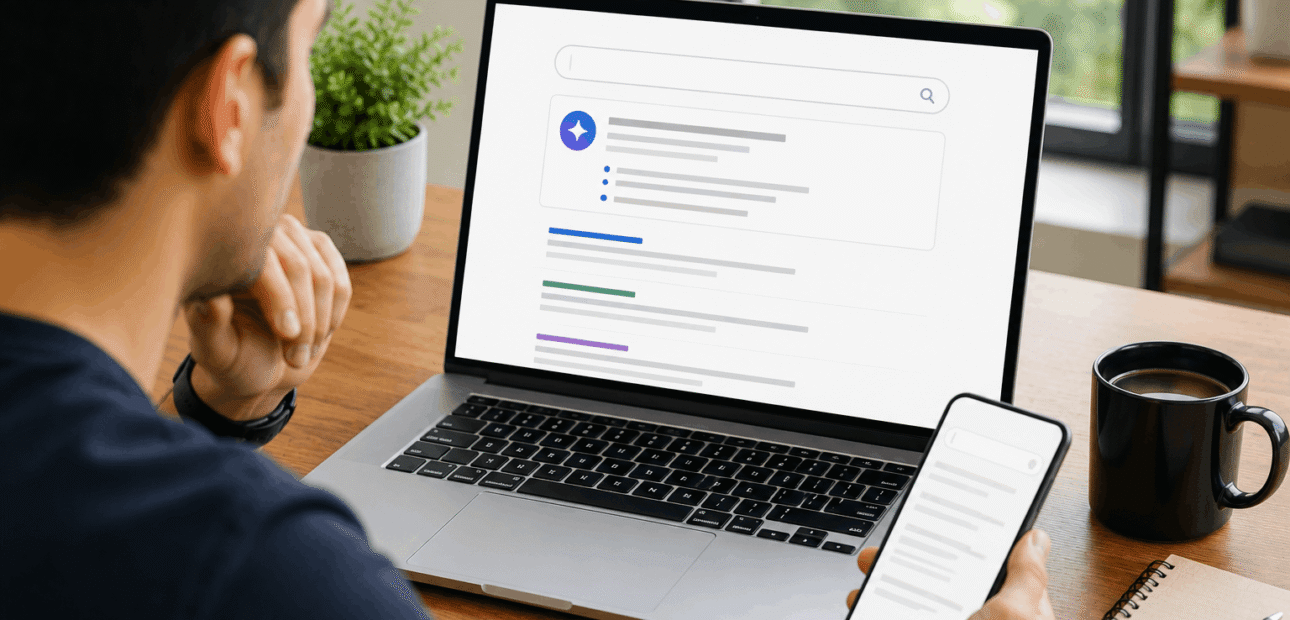
Think of it this way: Google, AI tools like ChatGPT and Perplexity, and social platforms are now answering people’s questions directly. Your audience is making decisions before they ever land on your website.
Zero-Click Marketing is how you show up in those moments.
Why Is Zero-Click Marketing Important Right Now?
Search behaviour has changed dramatically.
According to clickstream data from SparkToro and Similarweb, approximately 68% of Google searches now end without a single click to any website. On mobile devices, that number rises to around 77%.
That means nearly 7 out of every 10 people who search for something on Google never visit a website at all.
They get their answer directly from:
- Google’s AI Overviews
- Featured snippets
- Knowledge panels
- Google Business Profiles
- Maps and local results
- Social media content
This is not a temporary trend. It is how search works now, and it is getting more common every year.
If your entire digital marketing strategy depends on website traffic, you are already losing visibility to competitors who understand this shift.
How Did We Get Here? (The Walled Garden Problem)
Picture Google as a giant shopping mall.
Years ago, Google was like a mall entrance. It pointed shoppers toward individual stores (websites), and people walked in to browse.
Today, Google is the store. It shows product details, customer reviews, pricing, directions, opening hours, and answers to common questions, all without you ever entering a store.
A few real examples of zero-click searches:
- Someone searches “how many calories in an avocado” → the answer appears instantly in the results. No click needed.
- Someone searches “best accounting software for small business” → Google shows summaries, comparisons, and ratings before any website loads.
- Someone searches “weather in Mumbai tomorrow” → answered immediately on the results page.
This is what marketers call a “walled garden” — a platform that keeps users inside itself rather than sending them elsewhere.
Google is not alone. YouTube, LinkedIn, Instagram, TikTok, and AI tools like ChatGPT all do the same thing. They want users to stay on their platform.
Your job as a marketer is to be present and trustworthy inside those walled gardens.
The Measurement Problem Nobody Talks About
Here is where most marketers get confused.
They see their website traffic dropping and assume:
- Their SEO broke
- A competitor overtook them
- Their content became less relevant
In many cases, none of that happened.
What actually happened: The search engine changed how it shows results. Your content is still being read — it’s just being read on Google instead of on your website.
A dropping click-through rate does not always mean you are losing influence. It can mean your information is being consumed before the click ever happens.
Traditional metrics like sessions, pageviews, and bounce rate no longer tell the full story.
The new question to ask is not “Did they click?”
The new question is “Did they see us?”
The 3 Pillars of a Zero-Click Marketing Strategy
Winning at Zero-Click Marketing comes down to three practical things. Let’s go through each one simply.
Pillar 1: Write Atomic Content Blocks
An atomic content block is a short, self-contained answer — usually 40 to 60 words — placed directly under an important heading.
This is the most important writing change you can make for both SEO and AI visibility.
Why? Because AI systems like Google’s AI Overviews, ChatGPT, and Perplexity are constantly scanning the web for clean, easy-to-extract answers. If your answer is buried deep inside a long paragraph, it gets ignored. If it sits cleanly under a heading, it gets cited.
Example of a weak structure:
“There are many things to consider when thinking about what Zero-Click Marketing actually means for your business, and it’s important to think about how users behave when they search for information…”
Nobody — human or AI — wants to read that.
Example of an atomic content block:
What is Zero-Click Marketing? Zero-Click Marketing is the practice of building visibility and trust directly on search engines, social platforms, and AI tools — without needing users to visit your website first.
Short. Clear. Directly under the heading.
Practical rule: After every important subheading, write a 1–2 sentence answer that completely explains the topic. Then expand with details below it.
This structure works brilliantly for:
- Google featured snippets
- AI Overviews
- Voice search answers
- Perplexity and ChatGPT citations
Pillar 2: Use Factual Density in Your Writing
Most blog content today has a serious problem: it says a lot without actually proving anything.
Factual density means packing your content with specific, verifiable information — statistics, real examples, case studies, data points, and measurable results.
A simple rule to follow: include at least one concrete fact, stat, or example every 150–200 words.
Here is the difference:
Low-density (weak):
“Video content is becoming more important for brands.”
High-density (strong):
“Short-form video generates significantly higher engagement rates than static social posts across most major platforms, making it a priority channel for zero-click visibility in 2024.”
One is an opinion. The other is a useful claim with context.
AI systems are trained to recognise quality signals. They look for:
- Research findings
- Named statistics with sources
- Original observations
- Industry benchmarks
- Real-world case studies
The more factually dense your content is, the more likely it is to be cited by AI tools and trusted by human readers.
AI engines do not need another article repeating what everyone already knows. They reward content that contributes genuinely useful information.
Pillar 3: Build Your Off-Platform Brand Footprint
The third pillar of Zero-Click Marketing is about showing up everywhere your audience looks — not just your website.
Every time someone searches for a topic related to your business, ask yourself: Is my brand visible in this result?
That might mean:
- Your company is mentioned in a Google AI Overview
- A LinkedIn post of yours appears in search results
- Your Google Business Profile shows strong reviews and updated info
- A YouTube video of yours ranks in the search results
- Your name appears in an AI-generated summary
Even if none of these generates a direct click to your website, something powerful is happening: the person is learning your name.
This is called mindshare — and it compounds over time.
A potential customer might see your brand:
- In a Google AI Overview, while researching
- In a LinkedIn post a week later
- In a YouTube recommendation, a few days after that
By the time they are ready to buy, they search your name directly. That branded search is often far more valuable than any organic traffic click — because the trust is already there.
Studies consistently show that familiar brands convert at significantly higher rates because trust is established before the sales conversation even begins.
Every citation from an AI tool, every mention in a featured snippet, every appearance in a knowledge panel builds your digital authority. Think of it as the modern version of earning press coverage.
How to Measure Zero-Click Marketing Success
If clicks are no longer the full picture, how do you measure whether your Zero-Click Marketing strategy is working?
Here are the metrics that actually matter:
| Metric | What It Tells You |
|---|---|
| Branded search volume | Are more people searching for your name specifically? |
| AI citation tracking | Is your content being cited in AI Overview results? |
| Impressions (Google Search Console) | Are you appearing in more searches, even without clicks? |
| Share of voice | How often does your brand appear vs competitors? |
| Direct traffic | Are people coming directly to your site by name? |
| Social reach & mentions | Is your content spreading across platforms? |
Tools like Google Search Console, SparkToro, Semrush, and BrandMentions can help you track these signals.
Zero-Click Marketing vs Traditional SEO: What’s the Difference?
A lot of marketers ask this, so let’s make it clear.
Traditional SEO focuses on ranking your website pages high enough that people click through to them.
Zero-Click Marketing focuses on making your brand visible and credible at the point of search — whether or not a click happens.
They are not opposites. Zero-Click Marketing builds on traditional SEO. But it goes further by optimising for:
- AI-generated answers
- Featured snippets
- Social platform discovery
- Voice search
- Knowledge panels
If SEO is about ranking, Zero-Click Marketing is about being the answer — regardless of where that answer lives.
Frequently Asked Questions About Zero-Click Marketing
What does “zero-click” mean in marketing?
Zero-click refers to a search that ends without the user clicking on any external website. The user gets their answer directly from the search results page, an AI tool, or a social platform. Zero-Click Marketing is the strategy of building brand presence for these moments.
Is Zero-Click Marketing only for big brands?
No. Any business — local shops, freelancers, B2B companies, e-commerce stores — can benefit from Zero-Click Marketing. In fact, a well-optimised Google Business Profile is one of the most powerful zero-click tools available to small businesses.
Does Zero-Click Marketing replace SEO?
No. Zero-Click Marketing extends SEO. You still need good SEO fundamentals (technical health, quality content, backlinks). But you also need to optimise for AI Overviews, featured snippets, and off-platform visibility — that is where Zero-Click Marketing adds value.
How does Zero-Click Marketing work with AI tools like ChatGPT?
AI tools like ChatGPT, Perplexity, and Google’s AI Overviews pull answers from web content they trust. By writing clear, factually dense content with atomic answer blocks and proper schema markup, you increase the chance that your content is cited as a source in AI-generated responses.
What is the biggest mistake brands make with Zero-Click Marketing?
The biggest mistake is ignoring it entirely — continuing to measure only website traffic while missing the much larger audience consuming their content directly on search platforms. The second biggest mistake is not having a clear, quotable definition of what your brand does, making it hard for AI systems to include you in relevant answers.
How do I know if my content is appearing in AI Overviews?
Search your target keywords manually in Google and look for the AI Overview section at the top of the results. Tools like Semrush’s AI Overview tracker and SE Ranking now offer automated monitoring for AI Overview appearances.
What is generative engine optimisation (GEO)?
Generative Engine Optimisation (GEO) is the practice of optimising your content to appear in answers generated by AI-powered search tools — including Google AI Overviews, ChatGPT, Perplexity, and Bing Copilot. It is closely related to Zero-Click Marketing and is considered the next evolution of SEO.
Quick-Start Zero-Click Marketing Checklist
Use this checklist to start improving your zero-click visibility today:
Content:
- Add a clear 40–60 word definition under your main keyword heading
- Include a named statistic or data point every 150–200 words
- Add a FAQ section covering 5–7 common questions your audience asks
- Use short paragraphs (2–3 sentences max) for easy AI extraction
Technical SEO:
- Add Article schema markup with author, date published, and publisher
- Add FAQPage schema markup to your FAQ section
- Link all cited statistics to their original source URLs
- Submit your updated sitemap to Google Search Console
Off-Platform Presence:
- Claim and fully complete your Google Business Profile
- Publish consistently on LinkedIn (where Google often indexes posts)
- Create YouTube videos targeting your key search terms
- Aim for brand mentions on authoritative industry websites
Measurement:
- Set up branded keyword tracking in Google Search Console
- Monitor AI Overview appearances for your target keywords weekly
- Track direct traffic and branded search volume monthly
The Bottom Line
Search has changed. Most people are getting their answers without ever visiting a website.
That does not mean marketing is harder. It means the rules are different.
Zero-Click Marketing is about showing up where your audience is in AI answers, featured snippets, social feeds, and knowledge panels so that when they are ready to take action, your name is already the one they trust.
The brands that win in this new environment are not the ones with the most website traffic.
They are the brands that become genuinely useful and genuinely familiar everywhere their audience looks.
Start with one atomic content block. Add an FAQ section. Link your sources. Those three changes alone can meaningfully improve how AI tools and search engines represent your brand.
Trust is still the foundation of great marketing. Zero-Click Marketing is just the modern way to earn it.